A Portrait That Listens… Before It Speaks
This is the kind of photograph that does what I believe a portrait should do: it asks questions first, and only then—quietly—offers a few clues.
Who is this man?
Why is he here, in this particular space?
What is he listening for?
At first glance, the image feels straightforward. A man stands in a recording booth. There’s a microphone behind him, a screen glowing with waveform lines and text. The environment tells us what he does, or at least where he does it. Voice work. Audio. Something precise. Something considered.
But a good photograph never stops at the obvious.
The pose is relaxed, almost informal. His arms are folded, but not defensively. There’s an ease in the way he stands, a sense of familiarity with the space. This isn’t a visitor passing through; it’s someone who belongs here. The slight smile—knowing, but restrained—suggests experience rather than performance. He isn’t trying to impress the camera. He doesn’t need to.
And that’s where the photograph starts to open up.
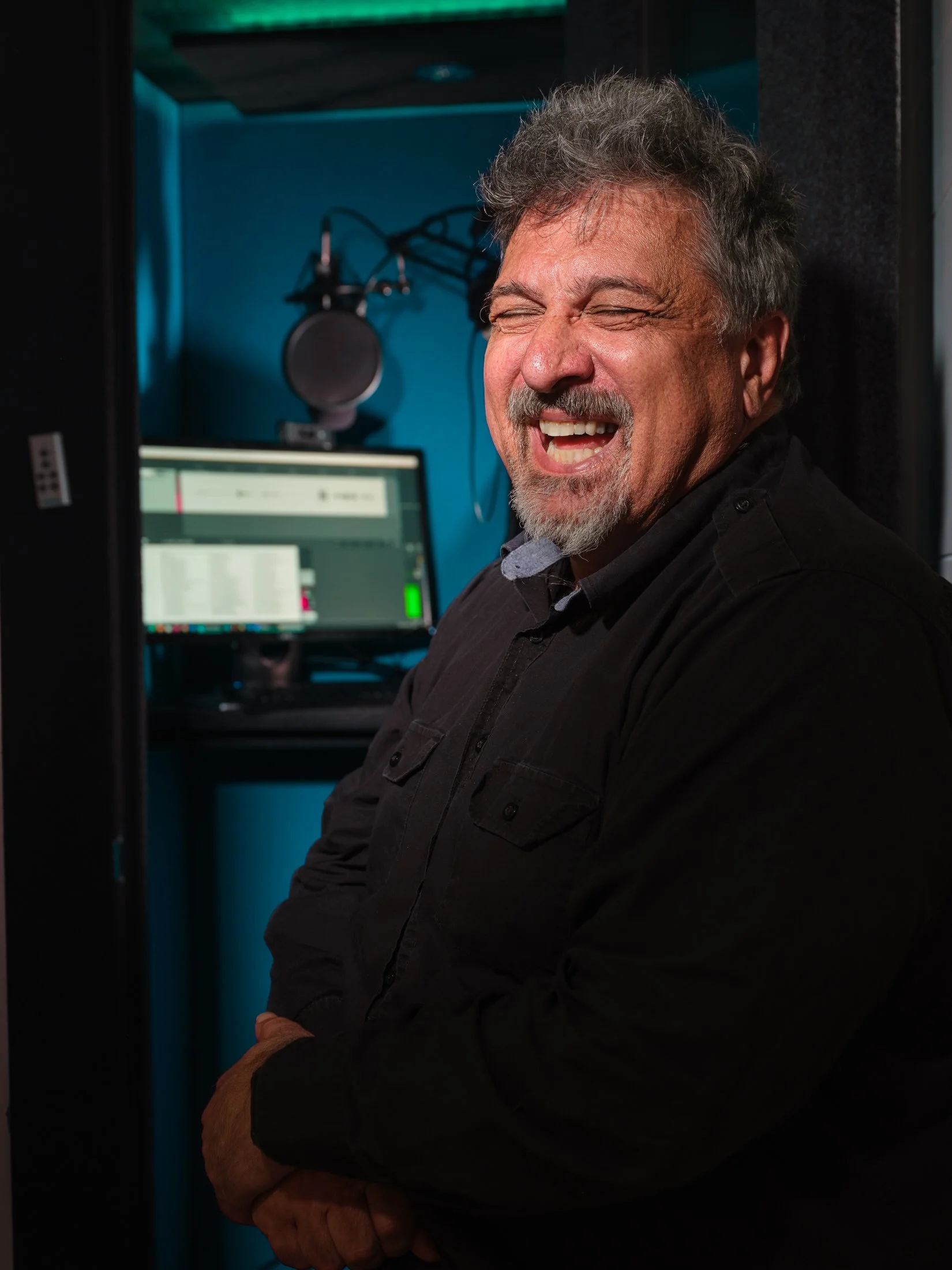
The booth itself becomes more than a backdrop. It’s a clue. A controlled environment designed to remove distractions, where only the voice matters. That raises questions about identity and craft. Is his work about precision, about interpretation, about storytelling? Is he the voice you recognise without ever quite placing the face? The image doesn’t answer those questions outright—and that’s deliberate.
What I’m always looking for in a portrait is that balance between revelation and restraint. Give the viewer just enough information to lean in, to start building their own narrative, but never so much that the mystery collapses. When everything is explained, there’s nothing left to explore.
Here, the lighting plays its part. The soft separation from the background pulls him forward, but the darker edges of the frame hold things back. The booth feels intimate, enclosed, almost secretive. You get the sense that something happens here—something private, repeated, practiced—but you’re not invited to witness it directly. You’re only allowed a glimpse.
That tension is important. A portrait shouldn’t feel like a conclusion; it should feel like the opening paragraph.
This photograph doesn’t tell you what his voice sounds like. It doesn’t tell you what he records, who hears it, or how often. It simply suggests that there is a story, and that he knows it well. The rest is left for the viewer to imagine.
For me, that’s the point.
A photograph should ask better questions than it answers—and trust the viewer enough to meet it halfway.
